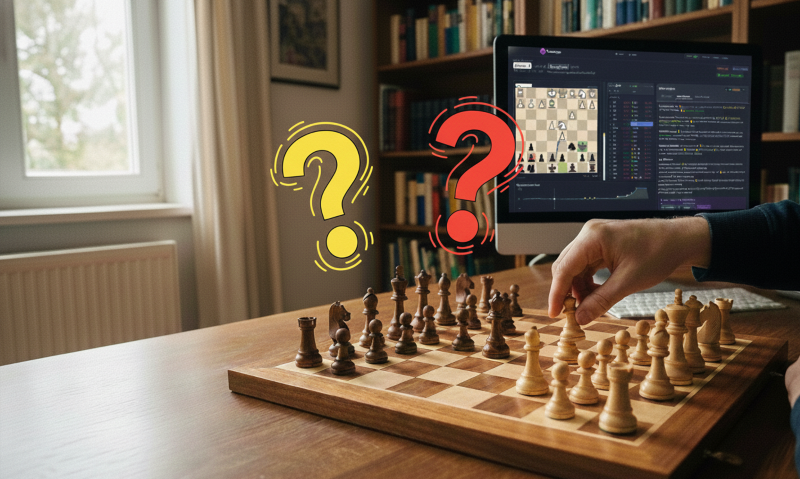
Stop Guessing at Your Mistakes: Meet ChessLogix
If you've ever stared at a Stockfish evaluation bar wondering "Why on earth is that a blunder?", you're not alone.
Engines are brutally strong, but they're terrible teachers. A cold +3.7 doesn't tell you why your move is bad, what habit led you there, or what pattern you keep repeating from game to game.
That gap is exactly what ChessLogix is built to close.
ChessLogix is a professional analysis tool, not a toy. It combines:
- Advanced reasoning models, prompted with the engine's own analysis of the position, and
- A rigorous Stockfish-based fact-checking pipeline that validates what they write
to give you trustworthy, in-depth explanations of your games — focused on the recurring habits that keep your rating stuck.
In this post, I'll walk through what the tool does, how it works, and how it can actually help you climb in a way raw engines never will.
Why "just using an engine" isn't enough
Let's be blunt: if "turn on Stockfish and stare at the top line" was enough to get strong, everyone would be a master by now.
The usual problems:
- You see
+0.4 → -2.8and a red "blunder," but- you don't really understand what you missed, or
- how to avoid a similar mistake in the future.
- You get lost in long engine lines that no human would find in a practical game.
- You don't build an understanding of typical structures, weak squares, piece placement, and time management – you just memorize random tactical shots.
ChessLogix is designed around a different question:
Not "what was the best move?" but
"What does this game say about the way you play chess?"
That's a much more useful question if your goal is long-term improvement.
The core idea: LLM reasoning + engine fact-checking
Under the hood, ChessLogix runs a hybrid pipeline:
- Stockfish provides deep, accurate evaluations and best lines.
- Reasoning models interpret those evaluations in human terms:
- move ideas
- positional concepts
- practical alternatives
- opponent's resources and counterplay
- Our chess fact-checker tools cross-check the LLM's claims against:
- engine evaluations
- legal moves
- concrete tactical details
The goal: dramatically reduce hallucinations while keeping the explanations rich and readable.
You get the best of both worlds:
- Engine-level accuracy.
- Human-like commentary tailored to your mistakes and habits.
One analysis, multiple perspectives
When you submit a game, ChessLogix doesn't just spit out a few random comments. It gives you several distinct lenses on the same game.
1. Game Stats – a performance snapshot
The Game Stats tab is your structured overview:
- Game Report (accuracy, mistakes, blunders, for both sides)
- Performance Metrics (proprietary indices like conversion, confidence, clutch performance, strategic stability)
- Time Management (how efficiently you used your clock vs your opponent)
- Time by Phase (opening / middlegame / endgame)
This is where you answer questions like:
- Did you throw away winning positions or convert them cleanly?
- Do you panic in time trouble or manage time reasonably well?
- Are your games decided by early blunders, or by a slow positional squeeze?
2. Move Analysis – "Why is this move bad?"
This is the tab most players live in when they first try ChessLogix.
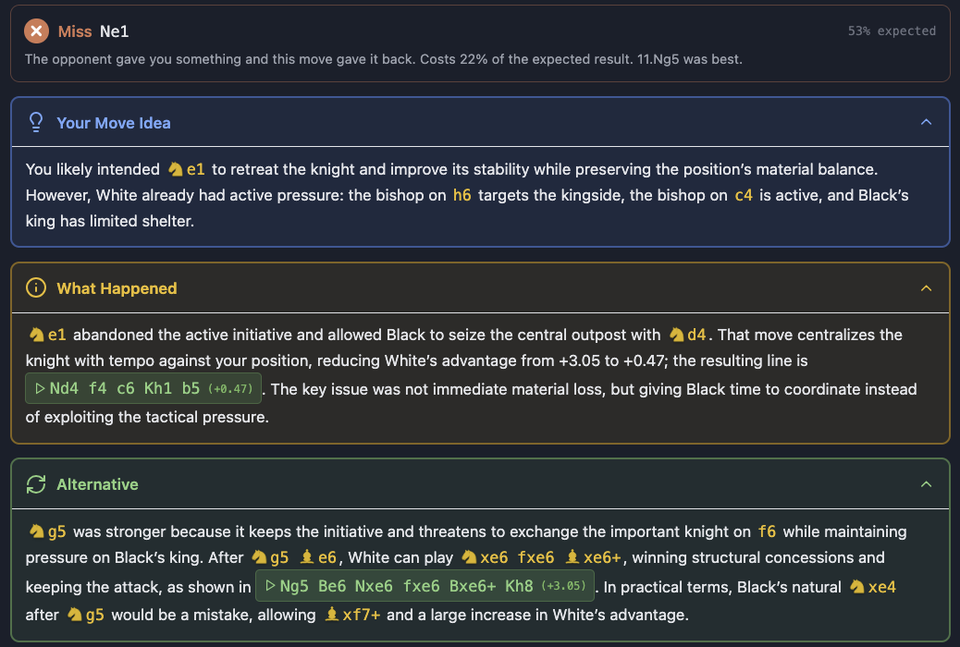
For any critical move, the tool gives you a structured explanation, for example:
- Your Move Idea – what you were trying to do.
- What Happened – how the position actually changed (weak squares, lost tempo, tactical liabilities).
- Alternative – a more principled move and why it fits the position.
- Opponent's Response – how a stronger opponent could punish you.
- Key Takeaways – the recurring pattern or habit underneath the error.
This is where the "professional tool, not a toy" distinction really kicks in:
- It doesn't just shout "Blunder!!" – it tells you "This queen move brings your queen out too early and leaves c6 as a tactical target; a quiet developing move like Nf6 fits the position better."
- As you review multiple games, you begin to see the same explanations pop up:
- "You rush pawn breaks without finishing development."
- "You move the same piece too many times in the opening."
- "You consistently underestimate weak dark squares around your king."
That's habit-level feedback, not random trivia.
3. Game Overview – the story of the game
Beyond individual moves, you get a structured narrative via the Game Overview tab, split into:
- Opening – how well you handled the chosen system, where you left theory, and whether your plans matched the structure.
- Positional – long-term plans, pawn structure, piece activity, king safety, and typical weaknesses.
- Performance – a high-level breakdown of:
- when you were winning,
- how you converted (or failed to convert),
- how stable your play was in critical moments.
This isn't fluff. It's meant to answer questions like:
- "Am I losing these games because I don't know the opening, or because I misplay the resulting middlegame structure?"
- "Do I give back advantages immediately, or do I slowly drift into worse positions?"
- "When I'm better, do I actually convert, or do I let the opponent back into the game?"
Built to expose recurring habits, not just single mistakes
Anyone can point out a tactic you missed once.
The real problem is what happens over and over:
- Always castling late.
- Pushing pawns around your king without understanding the weaknesses created.
- Playing a lot of "hope chess" sacrifices that don't quite work.
- Freezing in complex positions and burning all your time.
ChessLogix is engineered to highlight these patterns across your games, so that:
- You stop treating each blunder as an isolated accident.
- You see the underlying habit that keeps showing up.
- You can deliberately fix that habit, not just remember "I shouldn't play Qb6 in that one Sicilian line."
That's how you actually raise your ceiling and your ELO.
Why the LLM isn't allowed to "just make things up"
Large language models can be incredibly convincing – and sometimes confidently wrong. That's dangerous in a training tool.
ChessLogix is built with that in mind:
- Every move is backed by deep engine analysis.
- Explanations are run through our chess fact-checker tools that:
- verify tactics,
- cross-check evaluations and key lines,
- flag inconsistent claims.
Is it 100% perfect? No, and nothing is. But the point is to reduce hallucinations dramatically so that:
- If the explanation says "this loses a pawn by force," it actually does.
- If it calls a move "playable but inaccurate," that's grounded in engine reality, not model mood.
You get high-confidence feedback that you can trust when building your understanding.
How this actually helps your chess
Let's be concrete about the benefits:
- You stop feeling lost when Stockfish screams "blunder" – you get a clear human explanation.
- You learn patterns, not memorized lines:
- typical sacrifices that don't work,
- typical squares that matter in your openings,
- typical pawn structures you handle poorly.
- You get objective performance metrics that show whether your changes are working:
- Are your blunders fewer?
- Is your conversion of winning positions improving?
- Is your time management less chaotic?
Over time, as you analyze more of your own games with ChessLogix, you start to internalize:
- What good piece placement looks like.
- Which positions you personally tend to misplay.
- How to make decisions that are both practical and sound.
That's what actually moves the needle on your rating.
Who is ChessLogix for?
This is not a toy "fun facts about your game" app.
ChessLogix is aimed at players who:
- Already use engines, but want explanations instead of raw numbers.
- Are willing to review their games honestly and look at patterns in their play.
- Want a serious training tool that combines:
- modern AI,
- engine rigor,
- and a coaching-style perspective.
If you're a casual once-a-month player, you might find it overkill.
If you're actively trying to improve – especially in the 1300–2200 range – it's exactly the kind of lens you don't get from standard analysis pages.
Wrapping up
Engines solved the problem of "What is the best move?" a long time ago.
What they didn't solve is "How do I learn from my mistakes?"
ChessLogix is built to answer that second question:
- In-depth Game Stats to quantify your performance.
- Rich Move Analysis to explain critical decisions.
- Structured Game Overview to tell the story of the game.
- Advanced reasoning models, grounded in the engine's analysis, and continuously fact-checked against Stockfish.
So the next time you see "??" in your game, you don't just shrug and move on — you understand why, and you know what habit you need to fix.
That's how you stop spinning your wheels and actually move your chess forward.
Ready to improve your chess?
Connect your Chess.com or Lichess account and see what your own games say about how you play. The learning platform is free; AI Move Explanation and Meta-Coach are an optional membership.
Get Started Free