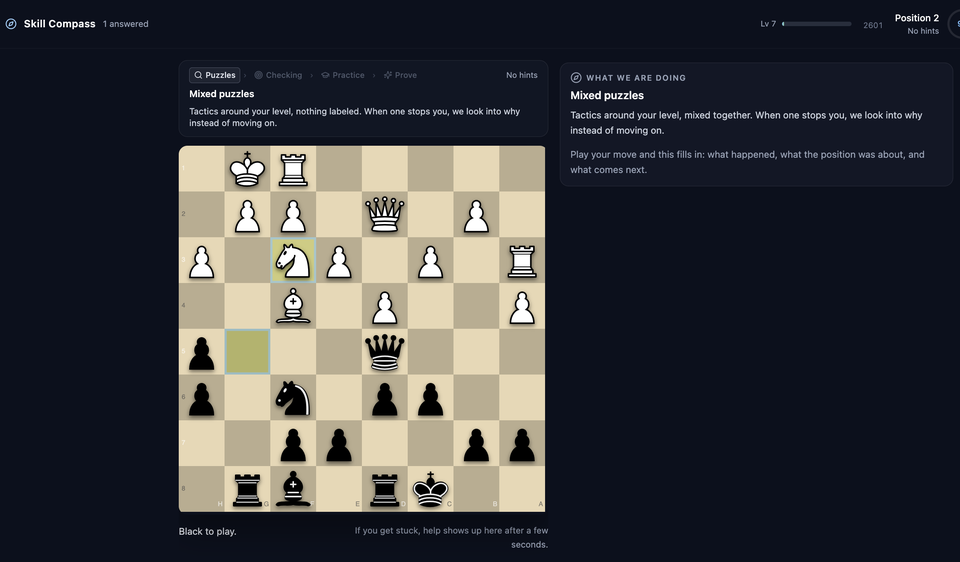
Skill Compass: The Tactics Trainer That Works Out Why You Missed It
Miss a puzzle in a normal trainer and it does one thing: lowers the rating and serves you an easier position. That is a sensible way to keep you comfortable. It is a terrible way to find out what you don't know.
Skill Compass is the tactics trainer we shipped in ChessLogix 2.0.1, and it starts from the opposite instinct. When a puzzle stops you, the interesting question is not how hard was that. It is which part of the idea broke — and until you answer that, every "personalized" puzzle you solve next is a guess.
Rating-Adaptive Feeds Adapt the Difficulty. Skill Compass Adapts the Lesson.
Here is the thing a rating-adaptive feed cannot distinguish. You miss a 1600-rated discovered attack. There are at least four different reasons that could have happened:
- You don't reliably see discovered attacks at all.
- You see them fine, but not when the board is this cluttered.
- You see them when they're there, but you missed the quiet preparatory move that creates one.
- You saw everything and moved too fast.
Four causes, four different remedies, and a rating adjustment treats them identically. So Skill Compass doesn't adjust the rating first. It follows up with a small number of closely matched positions — the same tactic on a quieter board, then the move that sets it up — and uses your answers to work out which of the four it was.
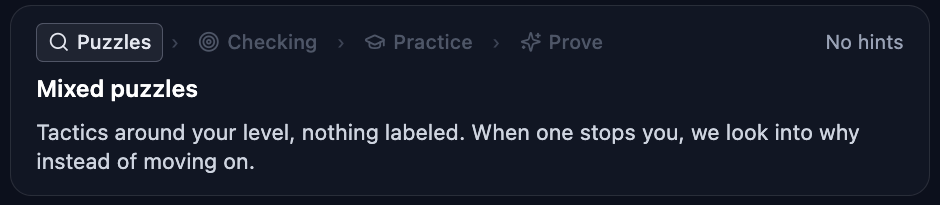
The track along the top always says which of four stages you're in, so a session never feels like an anonymous feed:
- Puzzles — mixed positions at your level, with nothing labeled. No theme, no hint, no "find the fork."
- Checking — a miss worth investigating gets follow-up positions that change one factor at a time.
- Practice — a short ladder rebuilding the idea from its plainest form upward.
- Prove — an unseen position carrying the same idea, solved with no help at all.
One Miss Is a Suspicion, Not a Diagnosis
This is the part we'd argue matters most, and it's the part that's easiest to skip when you build something like this.
A single miss is weak evidence. You might have been rushing. The position might have been harder than the rating implied. You might just have had a bad minute. If a trainer treats every miss as a confirmed weakness, it will spend your session teaching you things you already knew — and it will feel personalized while doing it.
So a miss opens a suspicion, not a lesson. Skill Compass then runs one to three matched-contrast probes, each altering exactly one factor from the position that stopped you. And there is a verdict it is genuinely willing to reach:
If all the probes pass, the suspicion is refuted. No ladder is built, and the session goes back to mixed puzzles.
Two other misses open nothing at all: a rushed miss, and a miss on a position the model didn't expect you to solve in the first place. Refusing to build a lesson is what makes the lessons it does build worth doing.
The Ladder Moves One Thing at a Time
When a suspicion is confirmed, the practice ladder rebuilds the idea in order: isolate it in its plainest form, vary the surface so you're learning the idea and not the picture, restore one obstacle the original position had, then prove it on an unseen equivalent. A retention check comes back for it later.
"One obstacle at a time" is a real constraint, not a description. If a stage can't be filled without breaking it, the stage relaxes the cosmetic requirements — a quieter board, fewer candidate captures — and never the lesson-defining ones. Every relaxation it takes is recorded and shown, because a position drawn after three relaxations is weaker evidence and should be labeled as such.
The controller responds to the kind of answer that arrived, not just right or wrong. Slow-but-correct moves sideways rather than up. Correct-after-a-hint holds the level and drops the hint. Two clean successes are required before the jump to the unseen challenge. And if an episode runs long, it gets parked rather than failed — you are not marked down for the trainer running out of suitable positions.
Help Arrives in Rungs, and It Costs Something
The clock softens at the recognition window; it never fires and never ends a position for you. If you're stuck, help arrives one rung at a time: first the name of the motif, then one relationship on the board, then the whole line.
Each rung is recorded with the time you asked for it, and each one reduces how much that position counts as evidence. That's deliberate. A solve after the motif was revealed is real knowledge and a real recognition failure, and collapsing those two facts into "solved" would quietly corrupt everything downstream.
It also means the three things Skill Compass tracks per tactic stay separate: recognition (did you see it), execution (could you play it out), and transfer (does it survive a different board). "Weak at forks" is three different diagnoses with three different fixes.
Eight Tactics, Tracked Separately
Skill Compass works from a bank of about 26,000 positions rated 800 to 2400, tagged across eight tactical patterns: forks, discovered attacks, pins, skewers, X-rays, deflection, removing the defender, and attraction or decoy. Each of the eight covers the whole 800–2400 range, which is what makes the follow-up positions possible — there is always a suitable one at whatever level stopped you.
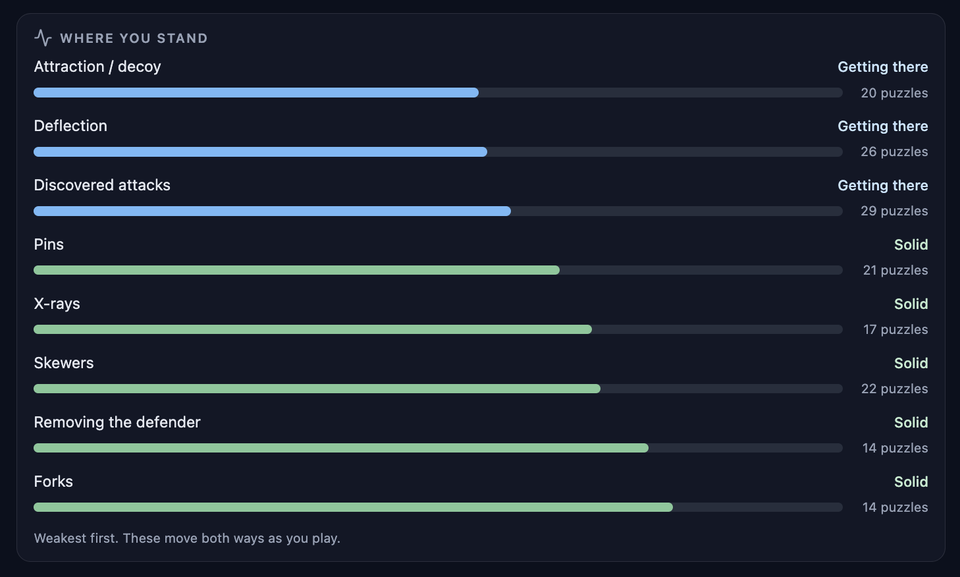
Each pattern gets its own reading, weakest first, and each shows how many puzzles that reading is based on — so a confident-looking label backed by four positions reads as what it is. This list is the queue your next session works down.
Your Rating Is What You Solve Unaided
One number on this page deserves an explanation, because it's the one that would be easiest to inflate.
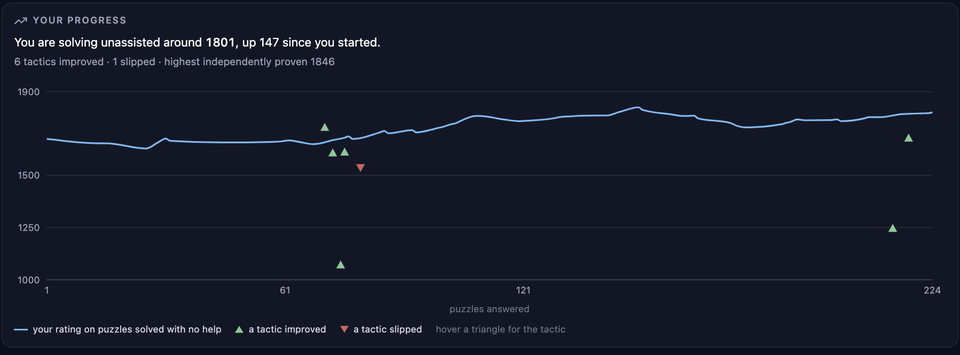
The line is your rating on puzzles you solved on your own — no theme shown, no hint taken. Practice positions are deliberately built to be solvable; counting them would only tell you that the puzzles got easier, which is not information. Green markers show a tactic that moved up in a session, red one that slipped, and hovering says which tactic and by how much.
The header states the same thing in one sentence: you are solving unassisted around 1801, up 147 since you started, plus the highest level you've independently proven. It is a smaller number than a hint-inclusive one would be. It is also the only version worth having.
What a Finding Actually Looks Like
To make this concrete, here is the shape of a typical finding:
- The finding: you recognize direct discovered attacks, but you keep missing the quiet move that creates one.
- Where it stopped you: a discovered attack rated 1510.
- Targeted practice: nine positions, rebuilding the idea from its plainest form upward.
- Unseen test passed: a position you had never seen, rated 1640, solved with no help.
Your own findings are named the same way, in the same plain terms. There is no vocabulary to learn before the report makes sense.
What It Costs, and What You Need
Skill Compass is free and unlimited, on any account. Not a trial, and not a metered feature — nothing in the loop calls an engine or a language model, so a session has no marginal cost and there is nothing to meter. Selection, prediction, the ladder and the scoring are all arithmetic over the puzzle bank.
You need a free account, because your sessions and the picture Skill Compass builds of your tactics belong to your account and there is nowhere else to keep them. You do not need to import any games — the bank is there, so you can start immediately. Importing your games opens up the rest of the free platform (game analysis, Opening Lab, and puzzles built from your own critical positions), but nothing here depends on it.
You'll find it as Compass in the navigation, or read the feature page at chesslogix.com/skill-compass.
Frequently Asked Questions
How is this different from Chess.com or Lichess puzzles?
Those adapt the rating; Skill Compass adapts the lesson. On a miss, a rating-adaptive feed serves an easier position from anywhere in the pool. Skill Compass serves closely matched positions designed to isolate which part of the idea broke, and only then builds practice around that one thing.
Do I need to import my games first?
No. Skill Compass runs entirely off its own bank of about 26,000 positions, so you can start a session on a brand-new account. Importing your games unlocks other parts of the platform, not this one.
Why does it sometimes decide my miss meant nothing?
Because sometimes it didn't. Rushed misses, misses on positions you weren't expected to solve, and suspicions where every follow-up probe passes are all closed without building a lesson. A trainer that finds a weakness every single time is not diagnosing anything.
Does taking a hint ruin the session?
No — hints are part of the design. They arrive in rungs, and each one is recorded and reduces how much that position counts toward your unaided rating. Take them when you need them; the numbers just stay honest about it.
How long is a session?
As long as you want. There is no fixed length, no daily cap, and no streak to protect. An episode — one full diagnose, practice and prove cycle — typically runs a handful of positions, and the track tells you where in it you are.
Find your next tactical breakthrough.
Start with a few mixed puzzles. The moment Skill Compass spots something worth training, it builds your first practice ladder around it. Free and unlimited, on any account.
Get Started Free