Free chess learning from your own games
Find the Mistakes That Keep Costing You Games
Import from Chess.com or Lichess. ChessLogix finds recurring weaknesses, shows where your openings break down, and turns both into focused training — free. AI Move Explanation and Meta-Coach are an optional monthly membership.
Start Learning Free View a Real Example
Free learning platform · No card required · Chess.com and Lichess
Chess.com and Lichess Already Analyze My Games. Why This?
Because a game analyzer answers one question about one game. The thing that is actually costing you rating is a decision you make in a hundred games, and no single-game report can see it.
| A typical game analyzer | ChessLogix |
|---|---|
| Reviews one game | Connects patterns across your history |
| Labels individual mistakes | Finds decisions that repeatedly cost you |
| Ends with an engine report | Routes findings into opening or puzzle training |
| Gives general accuracy | Tracks whether the same weakness appears less often later |
ChessLogix does not replace the engine review on the site you play on — it reads the same games and asks a different question.
- Public username only
- No platform password
- Delete imported games anytime
Your Games Become Your Training Plan
Four stages, in order. Each one takes its input from the stage before it, which is what stops these from being four unrelated tools.
- Diagnose
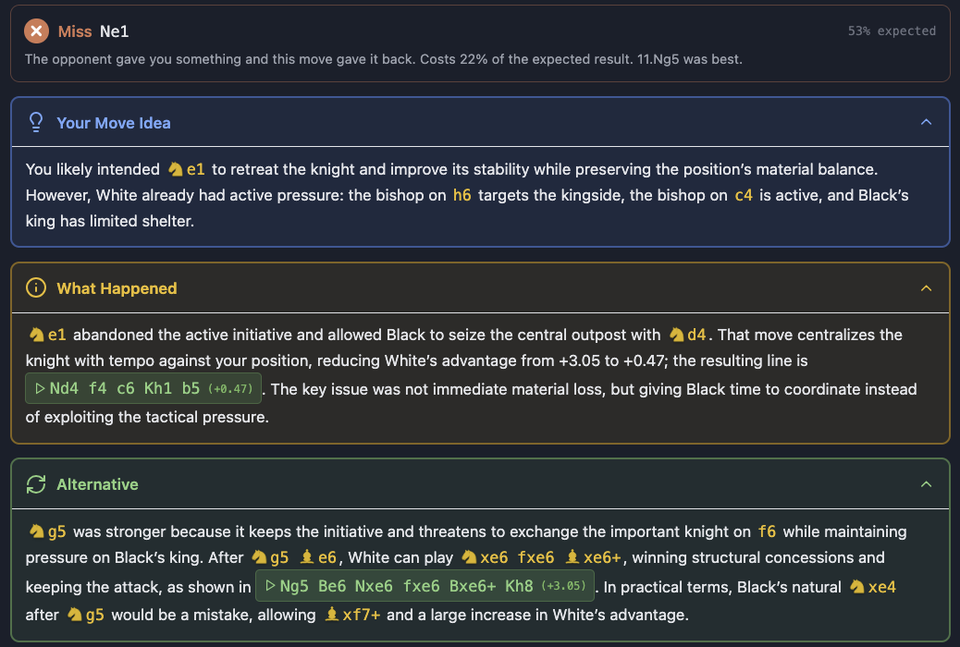
- Each game comes back as a written lesson — what your plan was, where it turned, and the rule to take from it. The findings are then counted across your history, so a habit separates from a bad day. How the analysis works
- Prepare
- Opening Lab walks the branches you actually reach and finds where your score drops. Practical alternatives come with the human result and the engine evaluation beside each other. Inside Opening Lab
- Train
- The exact position you missed shows you what you missed. A related position on a different board tests whether you can now find it. How the puzzles are built
- Track
- Import newer games and your picture updates. When a weakness you have been training turns up less often than it used to, you can see it. Recurring-mistake reports
What 27 Games Turned Into
One player’s import, followed from first analysis through to saved opening lines and puzzles. The numbers below are theirs — what your own games turn up depends on how you play.
- One weak opening branch, not one weak opening — The report followed the Italian Game past its name to the exact move order where this player’s score separated from the rest of their repertoire.
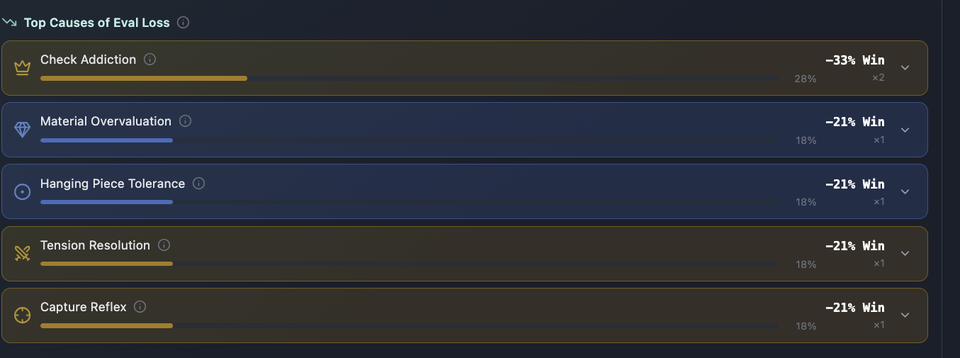
- One recurring decision, ranked first — Everything found across the 27 games was ranked by how often it happened and what it cost. Converting a clear advantage came out on top: 5 of 8 chances slipped, at a typical cost of 29.3% win probability.
- Four repertoire decisions and three puzzles — Generated from those findings — the saved lines with the reason each was chosen, the puzzles rebuilt from the positions where the evaluation actually turned.
Three Things You Get Back
- One coaching priority
- Not five things to work on. One current focus, chosen from a ranked list, with the numbers that chose it and a rule small enough to run in a blitz game. What the AI coach reports
- The branch where your openings break down
- Your own record beside human results for your rating range and time control, with the engine evaluation next to both — then the lines you choose saved as a repertoire you can rehearse. Inside Opening Lab
- Training built from your own positions
- First the exact position you missed. Then a different position that asks for the same decision, to test whether the idea survives on a board you have not seen. How the puzzles are built
Free to Learn, Membership for the AI Layer
Importing, engine analysis, Opening Lab, puzzles, Skill Compass and progress tracking are free — not a trial that runs out. Two features cost money to run on every use, because each one calls a large language model: AI Move Explanation and Meta-Coach.
ChessLogix — Free (No time limit)
The whole learning platform, with no time limit and no card.
Import your games, see where they went wrong, prepare the openings you actually play, and train the positions you missed.
- Chess.com, Lichess and PGN import
- Stockfish analysis, critical moments and move classifications
- Opening Lab, opening statistics and repertoire practice
- Blunder analysis and recurring-mistake tracking
- Puzzles built from your own games, and Skill Compass
- Training history and progress tracking
AI membership — $14.99/month
Adds the two AI features. Everything above stays free either way.
For when you want the reasoning written out in plain English, and one coach reading across all your games at once.
- AI Move Explanation — engine lines turned into plain English
- Meta-Coach — one priority read across your whole history
- Powered by agentic AI and large language models
- Billed monthly, cancel anytime
- The free platform stays free whether you subscribe or not
Questions People Ask First
What data is imported, and what is stored?
The games themselves — moves, clock times, result, time control, opponent name and ratings as they appear in the game record — for the handles you connect, plus everything derived from them: engine evaluations, explanations, opening statistics, extracted puzzles, saved repertoire lines and training history. ChessLogix reads public game data and never asks for your Chess.com or Lichess password. Individual games can be deleted, which removes the analysis derived from them.
What is free, and what needs the AI membership?
Importing games, engine analysis, critical moments, move classifications, Opening Lab, blunder analysis, recurring-mistake tracking, puzzles built from your games, Skill Compass and progress tracking are all free. Two features need the monthly AI membership: Move Explanation, which writes out in plain English what a move was going for and what it allowed, and Meta-Coach, which reads across your whole history to pick one priority. Some free features ask you to create a free account so your games and progress have somewhere to live — that is a login, not a payment.
Why are those two features paid?
Because they call a large language model every time you use them, and that costs money on every run. Stockfish analysis, opening statistics and puzzle generation are computed once and cost nothing to show you again, so they stay free. Charging for the two AI features is what keeps the rest of the platform free.
How many games do I need?
One game gives you a full single-game analysis straight away. Seeing what repeats takes more — a habit only stands out once the same situation has come up several times, so ChessLogix waits until it has seen enough before naming a pattern, and tells you how sure it is. Twenty games is a good first batch for most players.
Is a high human score the same as a good move?
No, and ChessLogix never merges the two. A human score says how players in a rating band did from a position with a clock running — practical difficulty. An engine evaluation says what the position is worth under deep search — soundness. Both are shown, labeled, side by side.
Will it raise my rating?
That is not something any tool can promise. What ChessLogix can show you is whether a habit you have been training turns up less often in the games you play afterwards.
Are Chess.com and Lichess both supported?
Yes, natively and equally: connect a handle on either platform, preview your games, and import. PGN upload covers over-the-board games and anything else. Several handles per platform are supported.
Start With Your Last Twenty Games
Connect Chess.com or Lichess with a public username, import a batch, and read what comes back. The learning platform is free and no card is required.