Common Chess Mistakes at 1200 Rating (And How to Fix Them)
If you're rated around 1200, you've moved past the complete beginner stage. You know how the pieces move, you understand basic tactics, and you can win games against players who make obvious blunders. But your rating has stalled — and you're not sure what's holding you back.
The answer is almost always the same: a small set of common chess mistakes at 1200 that appear in nearly every game, costing material, positions, and points. These aren't random errors. They're systematic habits that you'll keep repeating until you identify and deliberately practice against them.
This article catalogs the most frequent mistakes at this rating band, explains why each one happens, and gives you a prioritized fix list you can start working through today.
What Defines a 1200-Rated Player's Mistakes?
The most common chess mistakes at 1200 rating fall into a specific category: the player understands basic principles but fails to apply them consistently under game conditions. Unlike beginners who hang pieces through ignorance, 1200-rated players typically know that leaving a piece en prise is bad — but they still do it, because their checking habits aren't automatic and their calculation stops one move too early. The mistakes at this level are characterized by inconsistent application of known principles rather than lack of knowledge.
The 7 Most Common Mistakes at 1200
1. One-Move Threats Go Unchecked
The single biggest source of lost points at 1200 is failing to ask "What can my opponent do after this move?" before committing. The player has a plan, finds a move that fits their plan, and plays it — without scanning for the opponent's response.
This produces blunders like:
- Moving a piece away from a square it was defending
- Walking into an unprotected fork or skewer
- Allowing a back-rank mate that was preventable with one simple look
The fix: Before every move, run a 10-second scan: Checks, Captures, Threats. Ask what your opponent can check, capture, and threaten after your move. This single habit, practiced consistently, eliminates the majority of piece-hanging blunders. It's the highest-ROI change you can make.
2. Developing the Queen Too Early
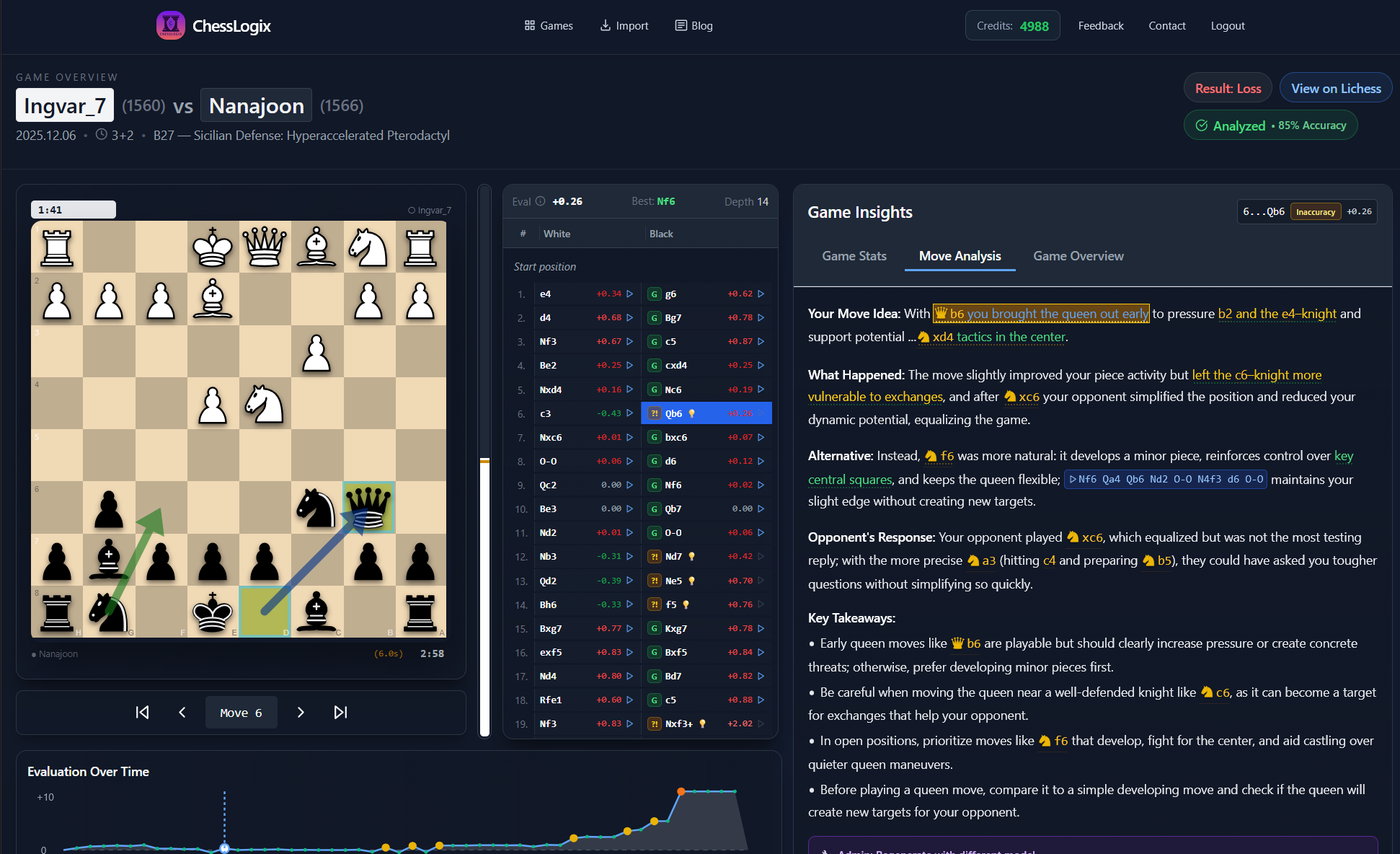
At 1200, players have often learned that the queen is the most powerful piece — so they bring it out early to "attack." The problem: the queen on an advanced square becomes a target. Your opponent gains tempo by developing their pieces while attacking your queen, and by move 10 you've moved your queen four times while they've developed four pieces.
The fix: In the opening (moves 1-10), develop knights and bishops before the queen. The queen belongs behind your army until the position opens. Exception: if there's a concrete tactical reason (like Qxf7 checkmate), of course take it — but verify it's actually sound first.
3. Ignoring Pawn Structure
1200 players think in terms of pieces, not structure. They'll trade pawns without considering what the resulting pawn skeleton looks like — creating isolated pawns, doubled pawns, and holes they'll suffer from for the rest of the game without realizing why their position is getting worse.
The fix: Before every pawn move, ask: "Is this pawn move creating a weakness?" Look for three things: Does it leave a pawn isolated? Does it create a backward pawn? Does it leave a square permanently weak? If the answer to any is yes, you need a concrete reason to justify the move.
4. Trading Without Purpose
When pieces collide in the center, 1200 players often default to capturing and recapturing without evaluating whether the trade favors them. This leads to trading active pieces for passive ones, swapping into worse endgames, and relieving tension when maintaining it would be stronger.
The fix: Before initiating a trade, ask: "Who benefits from this exchange?" If you're attacking, keep pieces on. If you're defending with less space, trades usually help you. In general, avoid trading your active pieces for your opponent's passive ones.
5. Castle Late (or Not at All)
At 1200, players frequently delay castling because they're "doing something more important" — pushing pawns, repositioning knights, or starting a premature attack. The result: their king sits in the center, exposed to tactical shots on the e-file and diagonal attacks that wouldn't exist if the king were safely tucked away.
The fix: Make castling a priority by move 8-10. Unless you have a concrete reason to delay (like a specific gambit line that requires it), get your king safe early. In most games, the player who castles first has a significant practical advantage.
6. No Plan in the Middlegame
The opening ends, the pieces are developed, and the 1200 player doesn't know what to do. So they shuffle pieces around randomly, waiting for something to happen. This aimless play gives the opponent time to build a coordinated attack or improve their position systematically.
The fix: When you've completed development and aren't sure what to do, ask three questions:
- What is my opponent's weakest point? (Typically an undefended pawn or a weak square)
- Which of my pieces is least active? (Move that piece first)
- Is there a pawn break available? (Central or wing pawn advances that open lines)
Even an imperfect plan is better than no plan. As decision pattern analysis shows, the most damaging habit at this level isn't making the wrong plan — it's having no plan at all.
7. Clock Mismanagement
1200 players commonly spend 3-4 minutes on non-critical early moves (overthinking known opening positions) and then rush through complex middlegame positions with 1-2 minutes left. The blunders don't come from the positions being too hard — they come from having no time to think.
The fix: Aim to spend no more than 20-30 seconds per move in the first 8 moves of your opening (you should know these already). Save your time for moves 12-25, where the real decisions happen. Track your time in post-game analysis — AI-powered analysis tools can show you exactly where you spent too long.
Priority Order: What to Fix First
Don't try to fix all 7 mistakes simultaneously. Here's the recommended priority based on rating impact:
- One-move threats (Checks-Captures-Threats scan) — Eliminates the most blunders per game. Fix this first.
- Castling early — Takes 2 seconds of effort per game, prevents an entire category of disasters.
- Clock management — Gives you time to actually think when it matters.
- Trading without purpose — Stops you from helping your opponent simplify into favorable positions.
- Middlegame planning — Replaces aimless shuffling with purposeful play.
- Queen development — Eliminates tempo loss in the opening.
- Pawn structure awareness — The most advanced concept on this list; build toward it as the others become automatic.
Each fix builds on the previous ones. Once the Checks-Captures-Threats scan is automatic (typically after 20-30 conscious games), move to the next priority.
Common Mistakes When Trying to Improve Past 1200
- "I need to study more openings." At 1200, your games leaving theory by move 5. The opening isn't your problem — the middlegame is. Spend 80% of your study time on tactics and the fixes above, 20% on openings.
- "I should watch more GM games." GM games are played at a level that doesn't translate to 1200 problems. Study annotated games aimed at your level instead, or analyze your own games and understand the specific types of mistakes you're making.
- "I need to calculate deeper." At 1200, the issue isn't calculation depth — it's calculation discipline. You don't need to see 6 moves ahead. You need to consistently see 2 moves ahead without skipping the check. Depth comes naturally as discipline becomes automatic.
- "Playing more games will make me improve." Volume without analysis is just repetition without learning. You'll reinforce your existing habits, not fix them. Play fewer games, analyze them thoroughly, and follow a structured analysis workflow.
Frequently Asked Questions
How long does it take to get from 1200 to 1400?
With focused training on the priority list above, most players can reach 1400 in 3 to 6 months. The key variable is consistency: 30 minutes of focused practice daily beats 5 hours on weekends. The Checks-Captures-Threats scan alone can add 100-150 points once it becomes automatic.
Should I focus on tactics or positional play at 1200?
Tactics first, by a wide margin. At 1200, roughly 70% of your lost games involve a tactical blunder. Get your tactical vision solid enough that you stop hanging pieces and missing one-move threats, then gradually layer in positional concepts. Positional play matters more starting around 1500-1600.
Are my mistakes different from a 1000 or a 1400 player?
Yes. At 1000, the dominant mistake is literally hanging pieces — leaving material en prise with no tactical justification. At 1200, you've mostly solved that, so the issues shift to inconsistent application (the Checks-Captures-Threats scan), structural mistakes, and planning gaps. At 1400, the dominant issues become calculation depth, endgame technique, and time management. Each rating band has a characteristic set of mistakes.
Is analyzing my games really worth the time?
This is the single highest-ROI activity for chess improvement after basic tactics training. A 20-minute analysis of one game where you identify your recurring mistakes is worth more than 10 games of unreviewed play. If you only have 30 minutes a day for chess, spend 20 on analysis and 10 on targeted puzzles. The games will take care of themselves.
Should I play rapid or blitz to improve?
Rapid (10-15 min per side) is the sweet spot for improvement at 1200. It's long enough that your mistakes reflect real thinking errors (not just time pressure), but short enough that you can play and analyze 2-3 games in a session. Use blitz (3-5 min) for fun and pattern exposure, but don't rely on it as your primary improvement vehicle.
Analyze one game free.
Upload a game and see exactly which of these mistakes appear in your play — with AI coaching to fix each one.
Get Started Free