How to Analyze Chess Games Step by Step
You just finished a game. Maybe you won, maybe you lost, maybe you ground out an exhausting draw. Now what?
Most players do one of two things: they click "New Game" immediately, or they flip on the engine and skim through arrows they barely understand. Neither approach leads to real improvement.
The truth is that how to analyze chess games effectively is a skill in itself — one that most players never learn. A solid post-game workflow turns every game you play into a focused training session, instead of a forgotten data point.
In this guide, we'll walk through a concrete, repeatable process for game analysis — from the first unaided review all the way to building a personal training plan. Whether you're 800 or 1800, the workflow is the same. Only the depth changes.
What Does It Mean to Analyze a Chess Game?
To analyze a chess game means to systematically review the decisions made during play, identify where and why critical errors occurred, and extract actionable lessons that transfer to future games. Effective analysis goes beyond finding the engine's top move — it connects each mistake to an underlying cause, whether that's a calculation error, a positional misunderstanding, or a recurring habit under time pressure.
Step 1: Review the Game Without an Engine
Before you open any analysis tool, replay the game yourself. This step is the one almost everyone skips — and it's the most valuable.
Go through the game move by move and ask yourself at each critical moment:
- What was I trying to do with this move?
- What was my opponent's plan?
- Where did I feel uncertain or confused?
- Which moves did I spend a long time on?
Write down (or mentally note) 3 to 5 moments where you felt the game shifted. These are your "candidate critical moments" — positions where something important happened, even if you can't articulate exactly what.
The purpose of this step is honest self-assessment. You're training your pattern recognition before the engine floods you with information. If you skip straight to the engine, you lose the chance to develop your own analytical instincts.
Step 2: Run Engine Analysis and Compare
Now open the engine. When learning how to analyze chess games properly, the engine is a verification tool, not the starting point.
Compare your candidate moments against the engine's evaluation chart. You'll typically find one of three outcomes:
- Your instinct was right — you identified the critical moment correctly. Good. Now dig into why the engine's suggestion is better.
- You missed a critical moment — the engine flags a big eval swing you didn't notice. This is a blind spot worth examining carefully.
- You flagged a moment that wasn't critical — the engine says the eval barely changed. You were worried about nothing, which tells you something about your threat assessment.
Don't just look at the top engine move. Look at what your move failed to address. Was there a tactic you missed? A strategic concept you didn't consider? A threat you underestimated?
This is where tools like AI-powered analysis add real value — they explain the why behind each evaluation shift, not just the what.
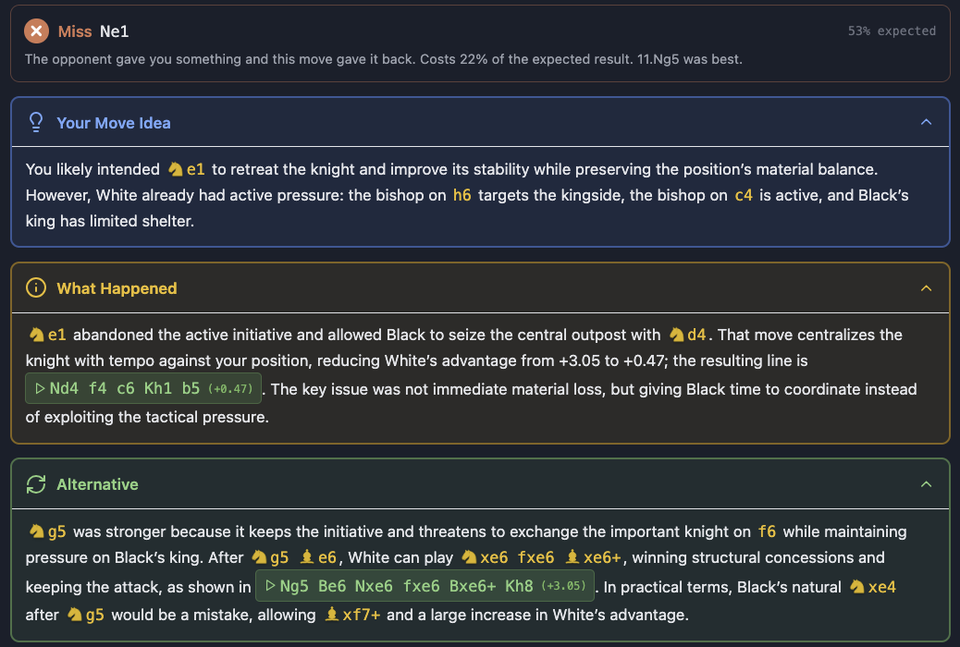
Step 3: Classify Your Mistakes
Not all mistakes are equal, and learning how to analyze chess games means understanding what type of error you're looking at. Every mistake falls into one of these categories:
- Tactical errors — You missed a concrete forcing sequence (fork, pin, skewer, mate threat).
- Positional errors — You made a structurally damaging decision (bad pawn break, weakened squares, misplaced piece).
- Time management errors — You spent too long in non-critical positions and rushed critical ones.
- Psychological errors — You played too passively when winning, too aggressively when defending, or made impulsive moves out of frustration.
For each significant mistake, write one sentence describing what category it falls into and what habit caused it. For example: "Tactical — I didn't check opponent's captures after my knight move" or "Psychological — I panicked after losing a pawn and started making random threats."
ChessLogix automates this classification with Decision Patterns — 16 named labels that map each eval swing to a specific, trainable habit. But even without automation, doing it manually builds your analytical muscles.
Step 4: Identify Your Recurring Patterns
A single game analysis is useful. But the real power comes from analyzing multiple games and spotting repetition.
After analyzing 5 to 10 games, look across your mistake classifications. You'll almost certainly see the same categories appearing over and over:
- Maybe you consistently miss back-rank threats.
- Maybe you always rush pawn breaks before finishing development.
- Maybe you play well through move 25 and then collapse in time pressure.
These recurring patterns are your real training targets. They're more important than any individual mistake because they represent systematic weaknesses that affect every game.
Prioritize your top 1 to 2 recurring patterns. Don't try to fix everything at once — pick the pattern that costs you the most rating points and focus there first.
Step 5: Build a Training Plan Around Your Findings
Analysis without action is entertainment, not training. The final step is converting your findings into a concrete practice plan:
- For tactical errors — Solve puzzles that specifically target the motif you missed. If you keep missing knight forks, practice fork puzzles daily for a week. Personalized puzzle training is far more effective than random puzzle sets.
- For positional errors — Study 2 to 3 master games in the same opening structure. Focus on where they place their pieces and which pawn breaks they avoid.
- For time management errors — Play your next 5 games with a deliberate clock strategy: spend at least 60% of your time on moves 10-25 (the critical middlegame decisions).
- For psychological errors — Before your next game, write down one rule: "When I'm winning, I will play solidly and avoid unnecessary complications." Then review whether you followed it.
The best analysis workflow in chess is a feedback loop: play → analyze → identify patterns → train targeted skills → play again and measure improvement.
Common Mistakes When Analyzing Chess Games
Even players who analyze regularly often fall into these traps:
- Only analyzing losses. Your wins contain just as many mistakes — sometimes more, because your opponent didn't punish them. Analyze everything.
- Memorizing engine moves instead of understanding concepts. Knowing that
Nf3was best in one specific position doesn't help if you don't understand why. Focus on the reasoning, not the move. - Spending too long on the opening. Unless you're above 2000, your games are decided in the middlegame and endgame. Don't spend 80% of your analysis time on the first 10 moves.
- Analyzing without writing anything down. If you don't record your findings, you'll forget them by tomorrow. Even a one-line note per game compounds into a valuable personal playbook over time.
- Skipping the unaided review. Going straight to the engine skips the most important part of the process — building your own judgment.
Frequently Asked Questions
How many games should I analyze per week?
Quality beats quantity. Analyzing 2 to 3 games deeply per week is far more effective than skimming 20. One thorough analysis where you identify and train a recurring pattern is worth more than a dozen superficial engine checks.
Should I analyze blitz games or only longer time controls?
Both have value, but rapid and classical games (10+ minutes per side) give you more meaningful data. In blitz, many mistakes come from pure time pressure rather than misunderstanding, which makes the analysis less actionable. If blitz is all you play, focus on the first 15-20 moves where you had time to think.
Do I need an engine to analyze my games?
You need both approaches — unaided review for building judgment, then engine verification for accuracy. An AI analysis tool adds the crucial third layer: explaining why sequences work rather than just which moves are best.
How long should a single game analysis take?
A thorough analysis takes 20 to 30 minutes for a rapid game. That includes the unaided review (5-10 min), engine comparison (10-15 min), and writing your takeaways (5 min). Resist the urge to analyze every single move — focus on the 3-5 most critical moments.
When should I start analyzing my games?
Immediately. There's no minimum rating required. Even at 600, you're making systematic mistakes that analysis can reveal. The earlier you build the habit of post-game analysis, the faster you'll improve — because you'll be learning from every game instead of just playing more volume.
Run this workflow on your own games.
Import a PGN or connect Chess.com or Lichess, and ChessLogix does steps 2 through 5 for you — critical moments, move classifications, recurring patterns and a training plan. Free, with no game limit.
Get Started Free