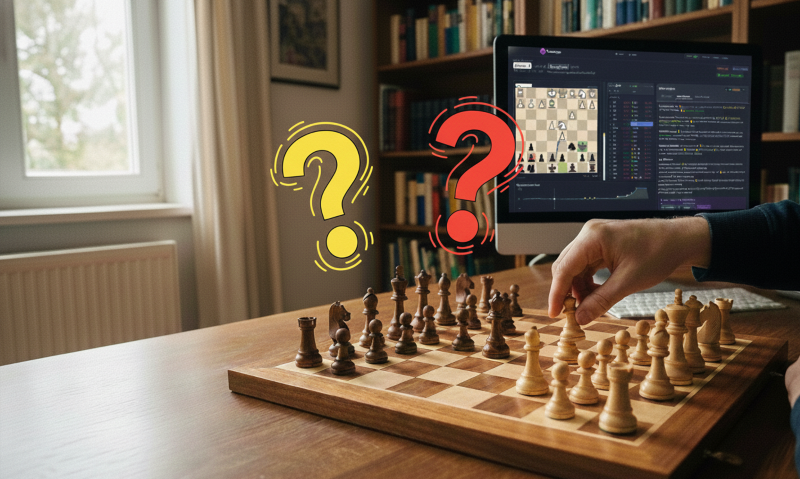
What Is AI Chess Analysis? Beyond Raw Engine Lines
Engines have been superhuman at chess for decades. Stockfish, Leela, and their successors can calculate millions of positions per second and assess any position with near-perfect accuracy.
So why do most players still struggle to learn from engine analysis?
Because engines answer the wrong question. They tell you the best move. They don't tell you why your move was bad, what habit led to it, or what you should practice to stop repeating it. That's the gap that AI chess analysis is designed to close.
In this article, we'll explain exactly what AI chess analysis is, how it differs from traditional engine output, where conventional tools fall short, and what to look for in an analysis tool that actually helps you improve.
What Is AI Chess Analysis?
AI chess analysis is the use of large language models (LLMs) and machine learning systems, in combination with traditional chess engines, to provide human-readable explanations of chess positions and moves. Unlike raw engine output that shows evaluation numbers and move sequences, AI chess analysis interprets engine data through a coaching lens — explaining why moves are strong or weak, identifying the underlying cause of mistakes, and connecting individual errors to recurring patterns in a player's games.
Where Traditional Engine Analysis Falls Short
Let's be specific about the problem. When you run Stockfish on one of your games, you see something like:
- A number:
+1.4after their move,-0.3after yours - A color-coded classification: "Mistake" or "Blunder"
- A suggested line:
Nf3 Re8 Bg5 h6 Bh4
And that's it. You're left to figure out:
- Why was your move worse? What concept did it violate?
- Is this a one-off tactical miss, or part of a larger pattern in how you play?
- What should you study or practice to stop making this type of mistake?
For players below 2000, interpreting long engine variations is essentially impossible. The engine suggests a 12-move sequence that no human would find in a real game, and the player clicks "Next Game" having learned nothing.
This isn't a problem with Stockfish. Stockfish is doing exactly what it was built for — finding the best move. It was never designed to teach.
How AI Chess Analysis Works in Practice
Modern AI chess analysis tools combine two systems:
- A chess engine (typically Stockfish) that provides accurate evaluations and best lines.
- A language model that interprets engine data and explains it in coaching-oriented language.
The engine provides the ground truth. The AI provides the explanation. Together, they give you something neither could offer alone: accurate, explainable feedback.
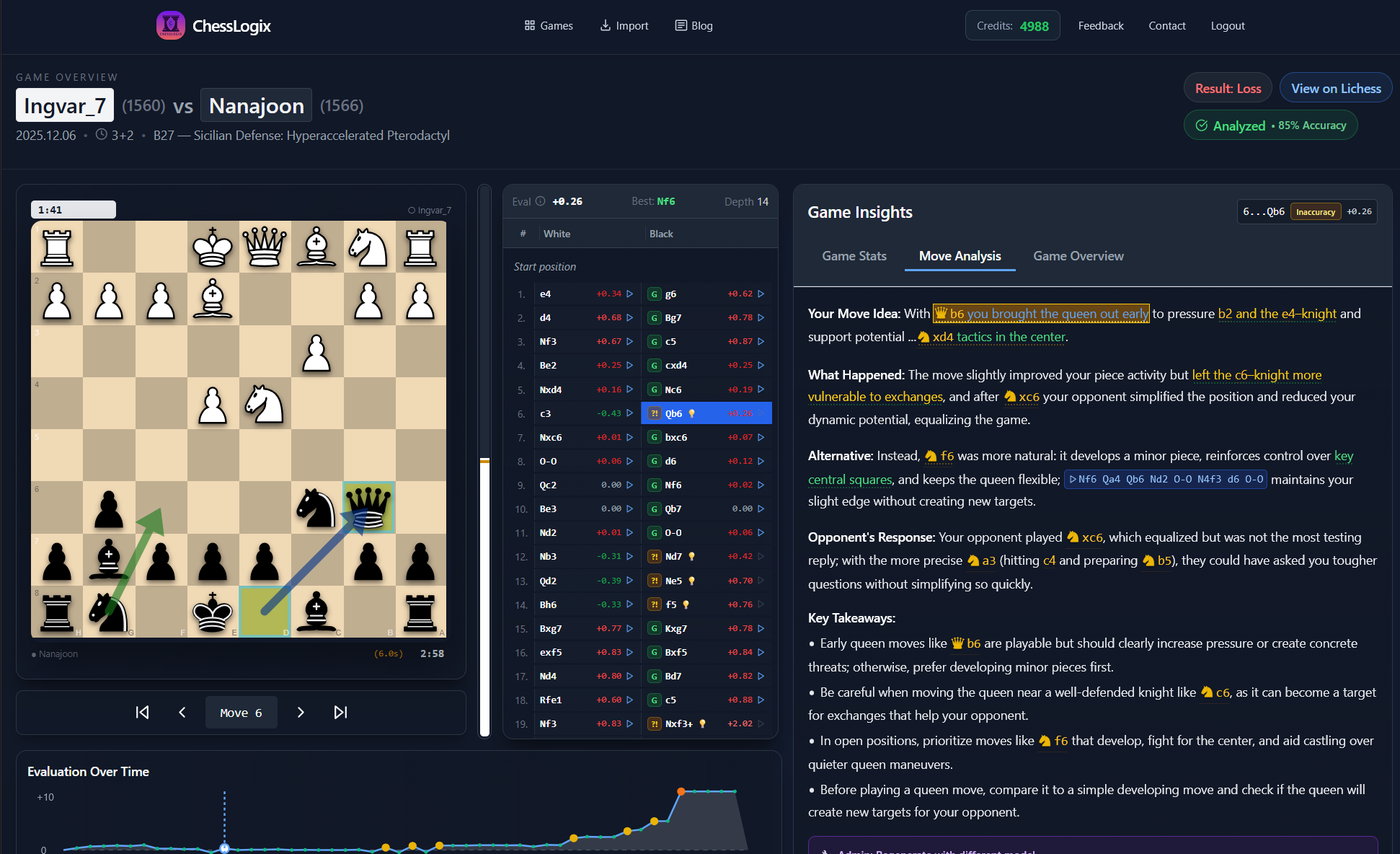
Here's what that looks like in practice. Instead of seeing -2.1 and a mysterious computer line, you get:
"Your bishop retreat to e7 was passive — it removes the piece from the action without addressing White's growing kingside pressure. The engine prefers Bg4, which pins the knight and forces White to make a concession before continuing the attack. This is a recurring pattern: when under pressure, you tend to retreat pieces rather than create counterplay."
That's the difference between data and coaching.
The Hallucination Problem — And How to Solve It
If AI analysis sounds too good to be true, you're right to be skeptical. Language models can produce confident, articulate explanations that are completely wrong. In chess, where concrete accuracy matters, a hallucinated explanation is worse than no explanation at all.
This is the critical engineering challenge in AI chess analysis: how do you keep the explanatory power of LLMs while ensuring factual accuracy?
The answer is engine-grounded fact-checking. A well-built AI analysis system doesn't let the language model operate unsupervised. It cross-checks every claim against engine evaluations, verifies tactical assertions, and flags inconsistencies before the explanation reaches the player.
ChessLogix uses exactly this architecture — the LLM generates coaching-style explanations, and a separate fact-checking pipeline validates them against Stockfish data. The result is feedback that reads like a human coach but is grounded in engine-verified reality.
What to Look For in an AI Chess Analysis Tool
Not all "AI analysis" tools are equal. Some simply paste engine output into a chatbot and call it analysis. Here's what separates a genuine tool from a gimmick:
- Engine-backed accuracy. Every claim should be verifiable against actual engine evaluations. If the tool says "this move loses a pawn," it should actually lose a pawn.
- Move-level explanations. You should get specific coaching on individual moves — not just a generic game summary. The value is in understanding each critical decision.
- Pattern recognition across games. A single game analysis is useful. But identifying recurring decision patterns across multiple games is where improvement actually happens.
- Actionable recommendations. Good analysis tells you what to practice. Not "play better" — specific drills, specific themes, specific habits to monitor.
- Performance metrics. Beyond move classifications, you need objective measurements: accuracy over time, conversion rates, performance under pressure, time management efficiency.
Common Misconceptions About AI Chess Analysis
- "AI analysis replaces engine analysis." No — it builds on top of it. The engine provides the foundation of accuracy. The AI adds the layer of explanation. You need both.
- "ChatGPT can analyze my chess games." General-purpose chatbots lack the specialized chess context, fact-checking pipelines, and position-specific analysis that a purpose-built tool provides. They'll sound confident while giving you wrong or generic advice.
- "AI analysis is only for beginners." Quite the opposite. Beginners benefit from basic tactical feedback the most. AI analysis becomes most valuable for intermediate players (1200-2000) who've moved past hanging pieces and need to understand positional and strategic patterns in their play.
- "More analysis means faster improvement." Reviewing 20 games superficially teaches far less than deeply analyzing 3 and acting on the findings. Quality of analysis beats volume.
Frequently Asked Questions
Is AI chess analysis better than working with a human coach?
They serve different roles. AI analysis provides instant, deep feedback on every game you play — something no human coach can match at scale. A human coach excels at building a long-term training plan and adapting to your personality. The best approach is using AI analysis between coaching sessions so you arrive with data-driven questions. Learn more about how AI coaching complements human coaching.
How accurate is AI chess analysis compared to pure engine analysis?
The engine evaluations themselves are identical — AI chess analysis tools use the same engines (typically Stockfish). The "AI" layer adds explanation, not calculation. The accuracy question is about those explanations: are they factually grounded? With proper fact-checking architecture, the answer is yes — but always verify critical tactical claims against the raw engine line.
Can AI chess analysis help me stop blundering?
Yes, specifically by identifying what kind of blunders you make and why. Knowing that you blundered is useless. Knowing that you consistently miss back-rank threats when your queen is on the other side of the board — that's actionable. Read more about the 8 distinct types of blunders and how to address each one.
Do I need to understand engine evaluations to use AI analysis?
No. That's the whole point. AI analysis translates engine numbers into coaching language you can act on. You don't need to know what +2.3 means in a specific position — the AI tells you "you're winning because your rook controls the only open file and Black's bishop is trapped."
Analyze one game free.
Upload a PGN or import from Lichess — see what AI-powered chess analysis actually looks like.
Get Started Free