Why Do I Blunder in Chess? The Real Reasons
You see it the instant you release the mouse. Your stomach drops. The move you just played hangs a piece, walks into a mate, or throws away a won game. Again.
Why do I blunder in chess? Every improving player asks this question — usually with increasing frustration after the third preventable loss of the evening. The standard advice is "just concentrate more" or "do more tactics puzzles," but neither answers the actual question.
Blunders aren't random. They aren't caused by a single failure of attention. They're the visible symptoms of specific, identifiable weaknesses in your chess thinking process — and each cause requires a different fix. In this article, we'll break down the real reasons behind chess blunders and give you targeted protocols to address each one.
What Causes Chess Blunders?
A chess blunder is a move that dramatically worsens your position, typically losing material or a decisive positional advantage. Blunders occur when a player's decision-making process fails at a critical moment — either by missing an opponent's threat, miscalculating a tactical sequence, making an impulsive move under emotional or time pressure, or applying a strategic concept incorrectly. The cause matters because different types of blunders require fundamentally different training approaches.
The 6 Root Causes of Chess Blunders
1. Threat Blindness — You Don't See What Your Opponent Can Do
The most common reason players blunder is that they simply don't look at what their opponent is threatening. They think about their own plan, find a move they like, and play it — without asking the most important question in chess:
"What is my opponent's best reply?"
Threat blindness causes everything from hanging pieces to walking into back-rank mates. It's especially dangerous because the player feels confident about their move — they just forgot to check the other side of the board.
Training protocol: Before every move, run a 10-second scan: Checks, Captures, Threats. Check what your opponent can check, what they can capture, and what new threats your move creates or allows. Make this scan automatic, like checking your mirrors before changing lanes.
2. Calculation Collapse — You Stop One Move Too Early
You see the first two moves of a combination. It looks great. You play it. Then your opponent makes one more move you didn't consider, and the whole thing falls apart.
Calculation collapse happens when you evaluate a line mentally, reach a position that "looks good enough," and stop calculating. The problem is that chess is concrete — "looks good" and "is good" aren't the same thing, and the difference is almost always one move deeper than where you stopped.
Training protocol: When calculating a forcing sequence, always ask "and then what?" at least one more time after you think you're done. Practice this with puzzle sequences that require 4+ move solutions — not to build speed, but to build the habit of calculating to completion.
3. Emotional Momentum — You Blunder Because of the Previous Move
You just lost a pawn. Or your opponent found a surprising resource. Or you missed a tactic that would have been winning. The emotional reaction to the previous event causes you to rush, panic, or overcompensate — and that's when the real blunder happens.
This is why do I blunder in chess after being in a winning position. It's not that your chess skill dropped — it's that your emotional state hijacked your decision-making. The psychology of loss aversion and frustration produces impulsive, uncharacteristic moves.
Training protocol: When something unexpected happens in a game, physically pause. Take your hands off the mouse or keyboard. Take a breath. Then assess the position fresh, as if you just arrived at the board. The 5-second pause between the emotional trigger and your response is the most important habit you can build.
4. Time Pressure Collapse — You Run Out of Clock and Stop Thinking
Under 2 minutes on the clock, accuracy drops dramatically for most players. Moves that would never be played with 10 minutes to think become the norm under time pressure — not because the player doesn't know better, but because there's no time to apply what they know.
Time pressure blunders aren't really chess problems — they're time management problems. The blunder at move 35 was caused by the 3 minutes you spent agonizing over a non-critical decision at move 20.
Training protocol: After each game, review your time usage. Identify where you spent too long on positions that didn't require it. Build a clock discipline: allocate roughly 60% of your time to moves 10-25 (the critical middlegame), and don't spend more than 30 seconds on any move in the first 8 moves of a standard opening you know.
5. Pattern Mismatch — You Apply the Wrong Template
Experienced players rely on pattern recognition — "this position looks like a King's Indian attack, so I should play f4-f5." But pattern recognition fails when the position doesn't quite match the template. A small difference (an extra pawn move, a slightly altered piece placement) can make the "standard" plan completely wrong.
This is a subtler cause of blundering, and it affects improving players more than beginners. You've learned enough to recognize patterns, but not enough to recognize when the pattern doesn't apply.
Training protocol: When you have a "this looks familiar" instinct, verify it concretely. Ask: "What is different about this position compared to the typical version?" Focus on pawn structure and king safety — those are the two factors most likely to invalidate a pattern.
6. Winning Position Anxiety — You Blunder Because You're Ahead
Paradoxically, many blunders happen when a player is winning. The anxiety of "don't mess this up" triggers one of two responses: excessive caution (shuffling pieces instead of converting) or reckless aggression (trying to end the game immediately with an unsound combination).
Both responses bypass normal thinking. The player stops evaluating the position objectively and starts playing based on their emotional relationship to the result.
Training protocol: When you're ahead, explicitly switch to a simple plan: trade pieces, keep your king safe, advance a passed pawn. Tell yourself "I will win this with boring, correct moves" — and mean it. The fancier your winning attempt, the more likely it is to backfire.
How to Diagnose Your Personal Blunder Pattern
The first step is figuring out which of the 6 causes accounts for most of your blunders. Here's a diagnostic process:
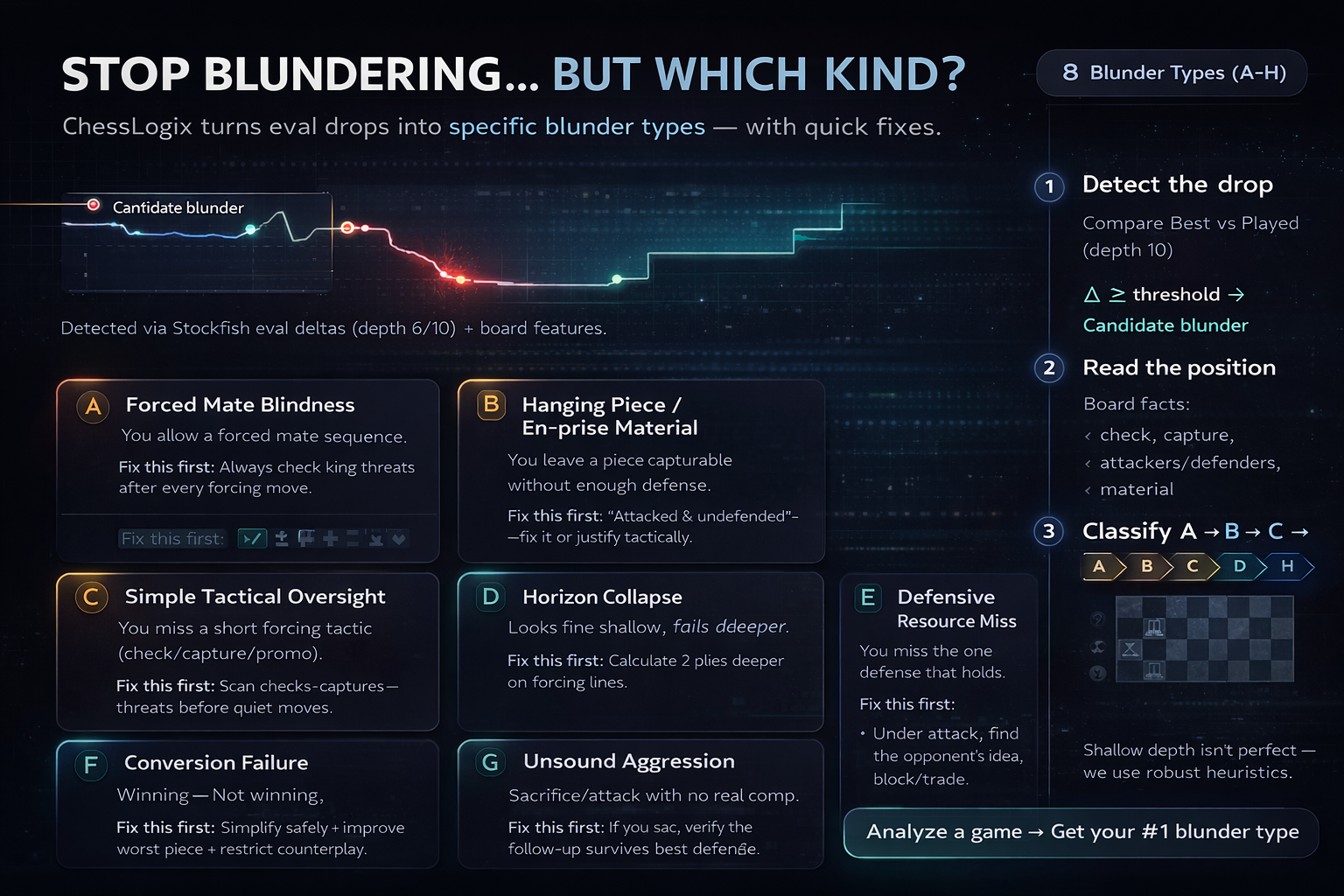
- Analyze your last 10 games. For each blunder, classify it: Was it a missed threat? A calculation error? An emotional reaction? Time pressure? A wrong pattern? Anxiety?
- Count the categories. You'll almost certainly see one or two categories dominate. That's your primary blunder type.
- Apply the specific training protocol for your dominant category. Don't try to fix everything at once — focus on the biggest leak first.
Tools like blunder analysis automate this classification by tagging each eval swing with a specific cause. ChessLogix's Decision Patterns system goes even further, tracking 16 named patterns across your games to identify exactly which failure modes appear most often.
Common Mistakes When Trying to Stop Blundering
- "I'll just solve more puzzles." Puzzles help with tactical vision, but they don't address threat blindness, time management, emotional control, or pattern mismatches. If your blunders aren't tactical, puzzles won't fix them.
- "I need to concentrate harder." Concentration isn't a switch you can flip. Better to build systematic habits (like the Checks-Captures-Threats scan) than to rely on willpower.
- "I should play slower time controls." Slower games give you more time, but if your blunder pattern is emotional momentum or pattern mismatch, the extra time won't help — you'll just blunder more slowly.
- "Strong players don't blunder." They absolutely do — just less frequently and in different ways. GM Ben Finegold famously noted that the main difference between him and amateur players is that he blunders less frequently. Blunder reduction is a continuous process, not a binary state.
Frequently Asked Questions
Why do I blunder more in winning positions?
Winning triggers anxiety and overconfidence simultaneously. You either become overly cautious (afraid of "ruining it") or recklessly aggressive (trying to end the game quickly). Both bypass your normal thinking process. The fix is deliberate simplification: trade pieces, eliminate counterplay, and convert with clear decision-making patterns rather than flashy tactics.
Does blundering decrease as rating goes up?
Yes, but the type of blunder changes. Below 1200, hanging pieces and missed one-move tactics dominate. Between 1200-1600, calculation collapse and pattern mismatch become the main issues. Above 1600, time pressure management and emotional control become the primary blunder sources. Each rating band has its own characteristic failure modes.
How many games should I analyze to identify my blunder pattern?
A minimum of 5 to 10 recent games is enough to see clear patterns. Focus on games where you blundered (not just lost — you can lose without blundering). Classify each blunder by cause, and the dominant pattern will emerge quickly. Analyzing more games just adds confidence to the pattern you've already identified.
Can blundering be a sign I'm actually improving?
Sometimes, yes. When you start reaching more complex positions (because your opening play improved), you may blunder more because you're navigating unfamiliar territory. This is a temporary increase in blunder rate that comes with expanding your chess. The key metric isn't whether you blunder, but whether you blunder in the same way repeatedly.
Is blitz making me blunder more in longer games?
Possibly. Blitz trains speed at the expense of discipline. If you play exclusively blitz, you may be reinforcing impulsive habits that carry over into longer games. The balance matters: use blitz for pattern exposure, but analyze your serious games to maintain quality thinking habits.
Find your recurring decision patterns.
Import a few games and see which of these causes actually dominates your play, with the moves that prove it. Free, with no game limit.
Get Started Free