What's New in ChessLogix 2.0.1
The last release we wrote up here was 1.0.59, which introduced Decision Patterns. Since then ChessLogix has gained two entirely new modules, rebuilt its training loop around them, and changed what the product costs. This is what's in 2.0.1.
The Change Underneath Everything Else: the Platform Is Free
Start here, because it changes how you should read the rest of this list.
ChessLogix used to run on analysis credits. It doesn't any more. Importing, Stockfish analysis, critical moments and move classifications, Opening Lab, puzzles, Skill Compass, the reports and progress tracking are free — not a trial, not a first-game-free offer, and with no limit on how many games you analyze. No card is required to use any of it.
Two features cost real money to run on every single use, because each one calls a large language model, and those are an optional $14.99/month membership:
- AI Move Explanation — engine lines written out in plain English, move by move.
- Meta-Coach — one coach reading across your entire history and returning a single current priority.
Everything else stays free whether you subscribe or not. If you read "free" on the site, you should not meet a paywall on your second game — that was the whole point of the change.
New: Opening Lab
The largest addition in 2.0.1. Opening Lab answers a question the rest of the product couldn't: not which openings do I score badly in, but which branch, and what should I play there instead.
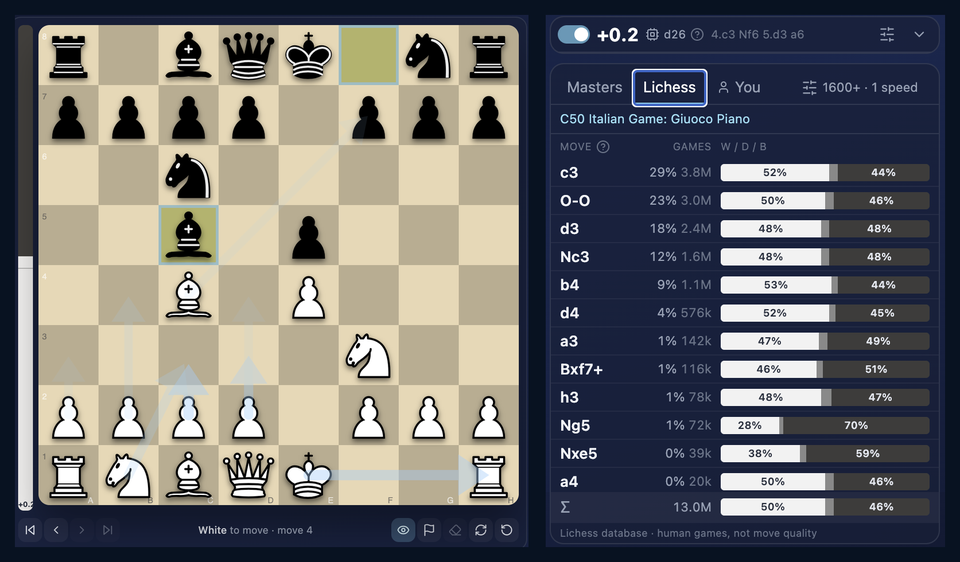
It ranks your openings from your own imported games, follows the tree down to the move where your score separates, and then shows two things side by side that it deliberately never merges: what the engine says the position is worth (soundness), and how players in your rating band and time control actually do from it (practical difficulty). Three sources — your games, the Lichess database, and Masters — always labeled so you know which you're reading.
The explorer then searches for candidate replies from a question you state explicitly: objectively strong or practically effective, against which opponent population, at which speed and rating band, and how much objective ground you're willing to concede. It runs in your browser at depth 16, and every line comes back with its practical score, the mistake rate it invites, the concrete punishment for the common inaccuracy, and what it cost you objectively — all separated rather than averaged.
What you save becomes a repertoire with the reason attached, not just a move order, and practice surfaces only the decisions that are due. Repertoire mode checks recall; sparring mode plays on past the end of your preparation, which is where preparation actually breaks. Transpositions are handled by position, so a different move order finds the same work. Any branch can be exported as PGN.
Full write-up here, or open the board — no login needed to explore.
New: Skill Compass
A tactics trainer built on a different premise from a puzzle feed. When a rating-adaptive trainer sees you miss, it lowers the rating. When Skill Compass sees you miss, it asks which part of the idea broke.
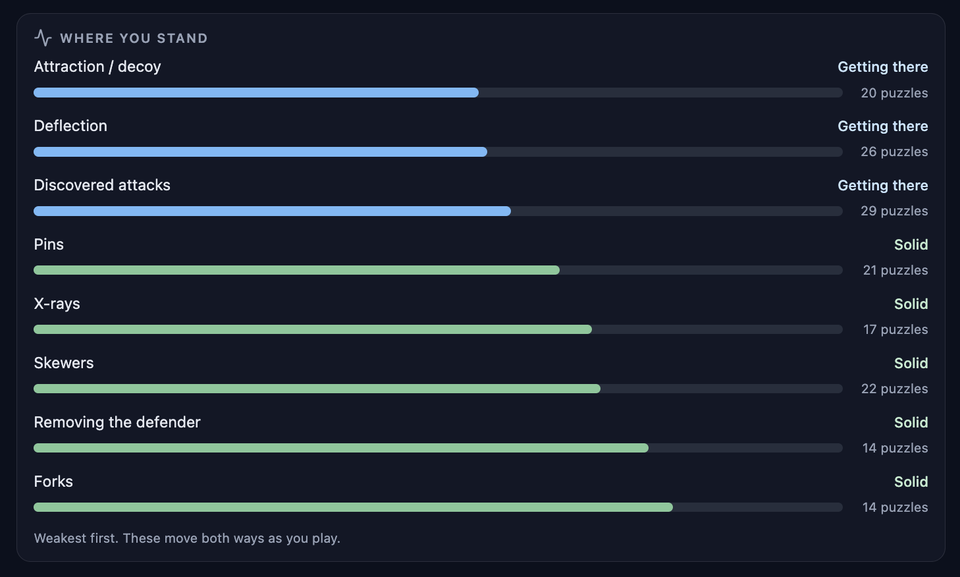
A miss opens a suspicion, which is then tested with a small number of matched positions that each change one factor. If they all pass, the suspicion is refuted and no lesson is built — a rushed miss and a bad minute are not weaknesses. If it's confirmed, you get a short practice ladder that isolates the idea and restores one obstacle at a time, then an unseen position to prove it on with no help at all.
It works from a bank of about 26,000 positions rated 800 to 2400, tracks eight tactical patterns separately, and rates you only on what you solved unaided — hints are available in rungs, and each one reduces how much that position counts as evidence. Free and unlimited on any account, and it needs no imported games to start.
Rebuilt: Personalized Training
The old puzzle pages have been replaced by a single Practice section that assembles one session from everything the platform knows about you.

A session draws from three sources at once, and says so: opening lines from the repertoire you saved in Opening Lab, puzzles carrying patterns you keep missing, and positions from your own games where the mistake actually happened. Sessions now track time per exercise and end with a report rather than just stopping.
Two things behind this got substantially better in 2.0.1: scanning your imported games for puzzle-worthy positions now keeps running while you explore the rest of the site, and the puzzle tagger gained a faceted ontology so that "similar pattern" means something more precise than a shared theme label.
New: the Progress Page
A page that answers four questions in order — am I improving, what is holding me back, is training reaching my games, and what should I train next — with the evidence underneath each answer rather than beside it.
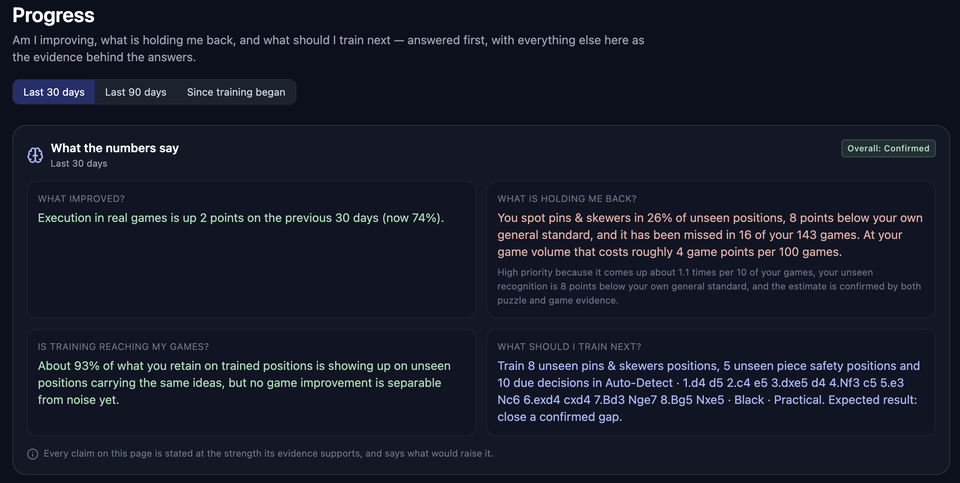
The part worth pointing at is the hedging. Every claim is stated at the strength its evidence supports, and the page says what would raise it. "About 93% of what you retain on trained positions is showing up on unseen positions carrying the same ideas, but no game improvement is separable from noise yet" is a more useful sentence than a confident number would have been, and it's the kind of sentence most progress dashboards refuse to write.
New: the Analyze Board
A dedicated analysis board at Analyze, for running the engine over a game or an arbitrary position without going through the full report pipeline. The engine runs in your browser, so there's no queue and no cost per position.
The game review page it grew out of also picked up per-branch PGN export.
Improved: the Coach
Coach analysis gained human counterfactuals — instead of only comparing your move to the engine's choice, it searches what a human opponent would plausibly have replied, which is a fairer test of whether your idea was actually bad or merely objectively second-best.
We also fixed a real bug worth naming: pattern evidence was being matched by pattern name rather than by ID, so a pattern could be shown with another pattern's supporting moves. Evidence is now matched by ID. If you read a coach report before this release and the example moves seemed not to fit the pattern, that's why — they may not have.
Smaller Things
- Multiple accounts. If you play under several Chess.com or Lichess handles, imports and statistics now keep them separate instead of blending a serious rapid account into a casual blitz one.
- Mobile game analysis. The game analysis page is usable on a phone now, which it honestly wasn't before.
- Navigation. One naming system across the app, the homepage and the feature pages, after a period where the same feature had three different names depending on where you found it.
- Lichess API caching, so opening statistics don't re-fetch the same population data on every visit.
- An admin dashboard and an email system behind the scenes.
What Didn't Change
The analysis core from 1.0.59 is intact and still free: 16 Decision Patterns detected from engine output and board features, the annotated evaluation chart, and the eight cross-game reports — Advantage Conversion Index, Decision Quality, Time Management & Pressure, Opening Scorecard, Castling & King Safety, Simplification & Trade Quality, Sacrifice Effectiveness and Error Profile Analysis.
What changed around them is the loop they sit in. In 1.0.59 the product could tell you what went wrong. In 2.0.1 the same finding becomes an opening branch to prepare, a tactic to train, and a position to re-solve — and then the Progress page tells you, with appropriate hedging, whether any of it reached your actual games.
Getting Started
Import from Chess.com or Lichess with a public username — no password — or upload a PGN. Analysis, Opening Lab, Skill Compass, puzzles and progress tracking are free with no game limit. AI Move Explanation and Meta-Coach are the optional membership, and everything else stays free either way.
Start learning free.
Import from Chess.com or Lichess and see what your own games say about how you play. The whole learning platform is free, with no game limit and no card.
Get Started Free